Are People Truly Predictable?

We were recently featured in a piece on the HR Matters site. We spoke about our work with 4G and how it can aid understanding and problem solving efforts. Here's a quick introduction.

We discussed the idea that people-based issues can be managed in a systematic and structured manner, something that Bruce is firmly in support of. 4G represents a proprietary approach developed by his company to understand and predict intangible aspects of people's personality, interaction and values. However, our conversation was not so much about 4G itself but about taking a holistic approach and the how's and why's of it.

The full piece can be found here and our thanks go out to Rowena Morais and Isabella Chan for bearing with us!

Posted in Articles & Research, 4G, General | 3 Comments

HR Executive Article – Boom or Bust for HR?

Anne Freedman at HR Executive very kindly published our "Boom or Bust for HR?" article back in January. Thanks Anne!

The introduction is below.

Is 2009 the year the HR function finally enters its ascendancy as organizations place greater emphasis on talent management and putting strategic HR activities at the heart of the business? Or is HR destined to remain a transaction-based cost center as leaders still struggle to rise to the challenge?

If you'd like to read the full version, it can be found here.

Posted in Culture, General, Leadership, Strategy, Articles & Research | Leave a comment

Productivity, pharmacology and work-life balance

Nick Carr takes a wonderfully tangential view on pharmacology and productivity.

I recently commented on the Nature editorial that made a case for "the responsible use of cognitive-enhancing drugs by the healthy."

The writers of the editorial, a distinguished group of academics, had noted that artificial "cognition enhancement" could boost the performance and productivity of many workers: "From assembly line workers to surgeons, many different kinds of employee may benefit from enhancement and want access to it."

In a posting today, the law professor Frank Pasquale takes the next logical step, offering a modest proposal for also allowing the use of "cognition-dulling drugs" by the healthy.

It brings a whole new meaning to work-life balance!

Posted in Intangibles, Leadership, Psychology | Leave a comment

We spend so much time smoothing things out…

We lose the opportunity for change, or for texture or creativity...

(at least according to Seth Godin)

Here's the full piece...

Is everything okay? Unless you work in a nuclear power plant, the answer is certainly no (and if you work there, I hope the answer is yes.) No, everything is not okay. Not in a growing organization. Not if your company is making change happen, or dealing with customers. How could it be? And yet, that's what so many managers focus on. How to make everything okay. We spend so much time smoothing things out, we lose the opportunity for change, or for texture or creativity. Instead of working so hard to make everything okay, perhaps it is more helpful to work hard at living with a world that rarely is.

Reading it again, do we really want things to be just 'ok' or do we need to revisit the mission statments again?

I think it was Henry Ford or was it Barack Obama who said;

Being OK is what makes America great

Can anyone remind me please?

Posted in Leadership, Psychology | 2 Comments

Leadership, Intangibles and Talent Review Q4 2008

Introduction

Welcome to the first issue of the Four Groups Leadership, Intangibles and Talent review. The purpose is to try to distil and comment on some of the more interesting and articles shaping the field. That said, the subject matter is not strictly defined but takes into account wider economic issues, particularly given the challenging climate. In this issue, articles have been included from the likes of Deloitte, IBM, McKinsey, The Hay Group and Towers Perrin.

Leadership, Intangibles & Talent Q4 2008 - Four Groups.pdf

There is no set criteria for inclusion, just that an article, survey or blog entry should be thought provoking, challenging or state more than the obvious. Comments and feedback are of course welcome

Summary - Q4 2008

Unsurprisingly, many articles are focusing on what it will take to emerge from the current downturn in a position of strength. As such the main themes focus on;

There seems to be considerable agreement that the organisations likely to manage and emerge from the downturn in the strongest position are ones which are; flexible, promote clear and consistent communication, are innovative and exhibit consistency between their internal and external behaviour. The theme tying all these attributes together is developing the ability to manage the intangibles of organisational behaviour, such as; social networks, collaboration, innovation and change.

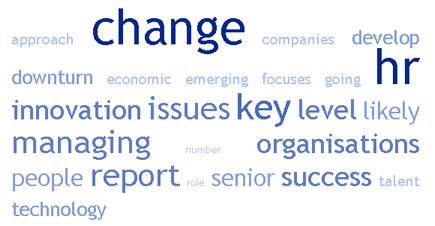
Tag Cloud

Leadership, Intangibles & Talent Q4 2008 - Four Groups.pdf

Continue reading

Posted in Intangibles, Leadership, Strategy, Articles & Research, General | 4 Comments

Sweet or sour?

Happy New Year!

Thanks to Coby, a video with some interesting reflections on economic circumstances from 2006 and 2007 ... sweet for Peter Schiff, sour for everyone else?

Posted in Culture, Strategy | Leave a comment

Is Malcolm Gladwell stating the obvious?

Malcolm Gladwell has been over to London, talking about his new book, The Outliers. I haven't read the book and I've only scanned the reviews, but the talent management component of the message seems to be that;

Outliers focuses more on the social and cultural context of individuals to explain their extraordinary success... Gladwell explains how success in the 21st century is less about sheer intelligence and more about collaboration and hard work

We're always in favour of collaboration, although concerning Gladwell, the BPS blog linked to a wonderful interview with Gladwell and Katie Couric in which Couric asks Gladwell if he is stating the obvious. Gladwell's reaction before answering is well worth the three minutes and preceding advert!

However you perceive Gladwell, it is wonderful to watch someone who has been so closely entwined with the zeitgeist for so long.

Posted in Psychology, Culture, Leadership | Leave a comment

Values go beyond ‘what you can get away with’

According to Stephen Green, chairman of HSBC Holdings;

Values go beyond ‘what you can get away with’ and that values are, in the end, critical to value – to sustainable value, that is

Green goes on to say;

“For companies, where does the responsibility for this begin? With their boards, of course. It is their job to promote a culture of ethical business throughout their organisation. It is true for banks at this time, but also true for all our businesses at all times.” Most of his industry colleagues wanted to do this and to be able to look at themselves in the mirror and know they were doing the right thing, he added.

Evidently, very relevant advice, if perhaps acknowledging that the horse has already bolted. That said, such sentiments go a long way to endorsing the opportunity and recognising the potential value that comes from successful leadership development.

Quotes via People Management

Posted in Culture, Leadership, Strategy | Leave a comment

Four Dimensions of Leadership

Nick McCormick very kindly sugested a podcast with himself on management tips. We had a good chat about some thoughts on leadership and spent about 10 minutes talking about;

  • Self Awareness
  • Relationships
  • Systems
  • Culture

I spoke a bit more about our own, Wilber inspired perspective on the topic. If you fancy a listen, the podcast is here.

Posted in Culture, Leadership | Leave a comment

Better returns from Talent Management

Michael Spect points us to an article and interview he did with Kate Carruthers. I've added some extracts from the piece below;

A fragmented approach to the elements comprising workforce development led to lack of integration and inability to align the workforce to current and future business demands.

Who’s doing it [Talent Management] well? According to Michael Specht no single organisation jumps out as doing it all well. Several are doing some bits well but nobody is doing it end-to-end as yet.

Research in the recently published Cedar Crestone 2008–2009 HR Systems Survey has found that organisations that extend their talent management strategy across the entire workforce have better returns.

This research is confirmed by another survey from IBM on the ROI of Talent Management, where it was noted that organisations "that apply talent management practices demonstrate higher financial performance compared to their industry peers".

Posted in Strategy | Leave a comment