HR Strategy and Strategy Execution

Max Goldman makes a very telling remark about the means and methods of adding value from a HR standpoint. Commenting on a 2006 Talent Management Survey Max writes;

The most interesting piece, I thought, was this quote from Averbrook: “Many organizations roll out a performance management system or workforce analytics system and simply just put it out there. They don’t do a good job of making sure that people know why these systems are implemented, show people the value of the systems, etc. So if organizations don’t market these systems to their employees, the employees will just think of them as another online tool and won’t actually use them to their full advantage.”

Surely this is another symptom of an old problem?

Posted in Culture, Strategy | Leave a comment

Emotional Injury Liability Insurance

I read an interesting post from Jerry Pounds at Management Issues. In short, the issue of intentional emotional distress can now carry a hefty penalty, at least in the US.

A hospital maintenance worker was recently awarded an $11.65 million jury verdict in Federal District court in Chicago against his employer for intentional infliction of emotional distress.

In an article in HR Magazine, Jathan Janove reports an increase in employee suits related to "discharge, demotion, pay cuts and other adverse employment actions."

According to Janove, employees sue not because of the specific action but because of the emotions created by the "perceived insult."

According to a 1999 study in Ohio, "employees who were not treated with dignity and respect were 35 times more likely to file claims (emotional injury) than those who were." Employee anger becomes employer litigation; a threat to employer liability and a risk management nightmare.

No doubt organisations will find this a challenge to react to and successfully meet. As Jerry writes;

For decades, the American worker has suppressed their anger about indignities and disrespect experienced because of an anachronistic class system perpetuated by inadequate leadership models. They harbored a burning anger that is finally finding expression and recourse in a sympathetic generation of judges and jurors.

Posted in General | Leave a comment

Hi everyone

Given Regina Miller's very warm and generous (re) introduction, I thought it only appropriate to say that as the coming days pass, I hope to be adding more posts and thoughts to the blog!

The absence was one of having too much to do and do little time in which to fit it all in - something had to give. I've been working on coaching and development material and a new website amongst other things. I'm also looking out for ideas and thoughts around metrics, ROI, HR business cases and the like. One of our new propositions is helping organisations link behaviour to costs, profits and business cases.

More to come in the following days 🙂

Posted in General | Leave a comment

Blending and Conceptual Integration

I've been doing some research on creativity and problem solving and have come across the idea of Blending. I think its a neat idea and one that possesses a great deal of power and application.

Blending is a concept which describes how we integrate, or blend, a number of different ideas into a single whole. The idea has roots in the study of language but it can be applied equally to many fields including creativity and problem solving. Originators of this work have include Turner (1996) and Fauconnier (1997) and their focus on CIN or a Conceptual Integration Network.

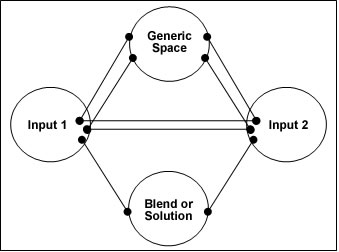
A simple diagram of Blending Theory

The diagram above outlines how, by combining generic space (or information) with two different inputs, a ‘blend’ or solution is created. One of the key ideas behind blending is the idea that while information is shared between the generic space and both of the inputs, it is the unique information that stems from the inputs that creates the specific solution. There are some further links and references below.

Links;
http://en.wikipedia.org/wiki/Talk:Conceptual_blending/Resources
http://www.humaniora.sdu.dk/~thewaywethink/encyclo.htm
http://markturner.org/blending.html

References;
Turner, Mark. 1996. "Creative Blends" and "Many Spaces." Chapters 5 and 6 of The Literary Mind. New York: Oxford University Press.
Fauconnier, Gilles. 1997. "Blends." Chapter 6 of Mappings in Thought and Language. New York: Cambridge University Press.

Posted in Psychology | 3 Comments

Some relationships are more equal than others

Meg Ellis made some comments on our 4G and Myers Briggs/MBTI posting .

The MBTI reported type code is a beginning point for people to determine their "best fit" type. They may behave differently from what their preferences are. Life is that way. Work demands we use aspects of ourselves that are not our favorite use of time. That's true in other aspects of our lives as well. Therefore, MBTI is not predictive of future behaviors.

That's one reason why there is no best pairing of people in significant relationships according to MB Type Code alone. There are benefits and challenges no matter who we partner with. Granted some are easier than others.

I assume that 4G measures traits or behaviors which can predict how successful a relationship can be. Not so with Myers-Briggs.

I think this is an excellent summation of one of the differences between MBTI and 4G. However, it also raises a question in my mind over how such instruments reflect day to day reality. Surely there has to be something deeper or 'better' to measure in order to represent people's own reality of relationships and that 'some (relationships) are easier than others'? Put another way,

...there is no best pairing of people in significant relationships according to MB Type Code alone

But in reality, we all know that some relationships are more equal than others!

Posted in 4G, Psychology | Leave a comment

From the moment we are born

"From the moment we are born, we spend the rest of our lives trying to understand ourselves" - Sue Gouldman.

I met Sue a week or two ago and thought that this quote was exteremly apt. Sue works in Careers Transition and obviously comes across people who are trying to understand themselves on a regular basis. This said, I think the quote has universal qualities.

Posted in General | Leave a comment

A Cacophony of Quantification

Many psychometric reports will feedback a series of numbers, graphs and sten scores in a cacophony of quantification. While one cannot underestimate the impact of a good visual aid, I am often left asking the question 'what do these numbers really mean'?

Take a score of 6 out of 10 for Extroversion for example. My question in this instance is what does 6 out of 10 actually look like? Given that it has been assigned quantitative meaning, surely it should correspond to standard quantitative rules? In other words, I should be able to observe an Extroversion score of 3 out of 10, point to it and have a tangible sense of its qualities. Unfortunately, this is far easier said that done and as for taking a score and halving it - forget it!

Consider, on the other hand, the measurement of water. We all know what a litre of water looks like, how much it weighs and we can easily divide it in half and so forth. However, while water and other physical objects do have the genuine properties of being quantitative, it remains to be seen just how genuinely quantitative the information in psychometric reports really is.

While my own point is made having seen some of the thoughts from Paul Barrett, the following makes this case far more eloquently than I ever could. The following extract is taken from Michell (1997)

The attitude of psychologists to measurement is said to display the signs of a methodological thought disorder. In this paper, the axioms of quantitative measurement are explained - and the consequences made evident for psychologists who might claim to be making “quantitative measurement”.

The abstract from the paper continues;

It is argued that establishing quantitative science involves 2 research tasks: the scientific one of showing that the relevant attribute is quantitative; and the instrumental one of constructing procedures for numerically estimating magnitudes. In proposing quantitative theories and claiming to measure the attributes involved, psychologists are logically committed to both tasks. However, they have adopted their own, special, definition of measurement, one that deflects attention away from the scientific task. It is argued that this is not accidental. From G. T. Fechner (1860) onward, the dominant tradition in quantitative psychology ignored this task. S. S. Stevens's (e.g., 1946, 1951) definition rationalized this neglect. The widespread acceptance of this definition within psychology made this neglect systemic, with the consequence that the implications of contemporary research in measurement theory for undertaking the scientific task are not appreciated. It is argued further that when the ideological support structures of a science sustain serious blind spots like this, then that science is in the grip of some kind of thought disorder.

References;
Michell, J. (1997) Quantitative science and the definition of measurement in Psychology. British Journal of Psychology, 88, 3, 355-383.

Posted in Psychology | Leave a comment

HR Strategy – Personal and Systematic Credibility

Liz Ryan at Business Week and Steve at Catbert (amongst others!) have all chipped in with the debate surrounding HR, credibility and HR's role within business. From my perspective, I think it is a two-fold issue, a combination of personal and systematic credibility. On the one hand, it is about personal credibility and standing up for yourself and your department. On the other hand and from the systemic standpoint, HR struggles to have the tools and techniques that win the credibility and buy-in of other parts of the business. Of course, both approaches are needed to move HR forward from its current position. Liz captures the problems around personal credibility here;

I fear the real problem is HR leadership credibility. It's lacking. When a leader is credible, people listen. We have a bad habit of putting noncharismatic, noncompelling business people into HR leadership spots, and it doesn't help the profession or our companies. If you want to make the case that building a robust organization is good for business, and you have to do that by means of an algorithm, you've already lost the war.

While the personal credibility piece is spot on, I think that there is a place for algorithms. Consider the algorithms involved in accountancy, corporate finance, or even the use of NPV calculations (Net Present Value). These are often everyday parlance for strategists and senior executives and accordingly, they allow a sound commercial point to be made. This of course isn't to say that HR can immediately jump into the world of metrics and quantification (see Putting a Number on HR?) but that a method that drives obvious value and quickly solves people-based problems would go a long way in this situation. However, to quote Liz again and her own view of the status quo

We HR leaders are parties to our own powerlessness -- and the reason is that we accept it.

Acting and exploring systematic methods for HR, along with building personal credibility surely has to be a step in the right direction here?

Posted in Strategy | 1 Comment

4G and Myers Briggs/MBTI

Myers Briggs (or MBTI) is possibly the most popular psychometric is use today and there is no shortage of people who write about this model. Given, however, some of the similarities between Myers and 4G, people often ask what the key differences are. In essence, 4G introduces the idea of Social Relationships and more specifically, a framework which outlines optimal relationship combinations. The following re-written extract is taken from the Myers Briggs site and hopefully highlights this point. The italics show the changes added whilst the original is shown below.

Type differences in relationships can be a source of growth and/or conflict. However, within 4G, there are a number of ideal or more successful combinations of types in relationships than others.

The original from the Myers Briggs site follows.

Type differences in relationships can be a source of growth and/or conflict. However, there are no best or more successful combinations of types in relationships.

Posted in 4G, Psychology | 2 Comments

Is the glass half full or half empty?

People often use the metaphor of the glass being half full or half empty to talk about positive or negative perceptions.

Is the glass half full or half empty?

While this of course has its place, I was particularly impressed by a re-working of this quote by a client. They said;

The glass is always full, it just depends if you want the glass to be full of air or water

Posted in General | 4 Comments