


Our thoughts and sympathy is with the victims of the London bombings today. Hopefully this is the last successful terrorist attack of our times and that the perpetrators turn to peaceful means to progress their own agendas.


Leadership Theories
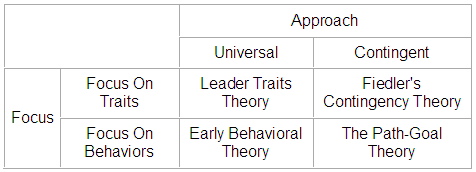
I've been doing some research into leadership theories and have found what I think is a useful matrix and approach for categorising much of what is already out there. The matrix is from the work of Arthur G. Jago and it looks at focus and approach.
Jago's Framework of Leadership Theories:
The following is taken from the Leadership Theories page on About.com;
"Focus" refers to whether leadership is viewed as a set of traits or as a set of actions. Focus on Traits: Theories with such a focus see leaders as having certain innate or inherent personality traits that distinguish them from non-leaders. These personality traits are supposed to be relatively stable and enduring. Focus on Behavior: Theories with this type of focus see leadership as observable actions of the leader instead of personality traits.
"Approach" is concerned with whether a particular theory or model of leadership takes a universal or a contingent perspective. Universal Approach: This approach believes that there is a universal formula of the traits or behavior for an effective leader. In other words, the universal approach assumes that there is "one best way" to lead in all situations. Contingent Approach: Contrary to the universal approach, the contingent approach does not believe the "one best way" formula. It believes that effective leadership depends on the specific situation.
If we take each of these quadrants in turn, I would place the well known psychometrics into the Universal Traits box. This would include 4G, NEO, 16PF and MBTI amongst others. Universal Behaviours would link to the idea of competencies and is perhaps less empirical than traits. We wrote a piece which outlines these differences called "Character traits and their use". I think Contingent Traits would hope to be picked up by 360 degree feedback and appraisals. Certainly, 360 degree feedback is reasonably objective and would often focus on specific 'traits'. Finally, I would include things like NLP and Situational Leadership into the final quadrant, Contingent Behaviours. These seem to be very contextually driven and highly pragmatic in nature.
Anyway, I hope this breakdown is reasonably clear. Its certainly helped me to explore things in a little more depth.
Posted in Psychology 1 Comment
Text versions of our articles
Just a quick admin note to say that there are now some text versions of our articles online, along with the pdf versions that are avaliable if you register.
Actions for Enterprise Collaboration - White Paper.
Companies need to innovate relentlessly to even stand still in an increasingly global and competitive economy. No longer is it sufficient to deliver incremental improvements at a leisurely pace. Instead disruptive innovations of the type that fundamentally alters markets and business processes must be sought out and delivered regularly and predictably. Disruptive innovation must become a core business process. This article shows how to achieve this.
An Integrated Model for Strategic HR - Article.
Outlines 4G as encompassing traditionally disparate areas of HR and offering new, interlinked solutions.
Using Social Relationships to Optimise CRM - White Paper.
This white paper shows how Social Relationships can be used for the purpose of systematically managing and optimising Call Centres and CRM functions. Specifically it focuses on improvements in productivity and performance.
Boosting Team Performance - White Paper.
Illustrates a number of team building and management myths, along with introducing 10 attributes of successful teams.
Systematic Team Building - White Paper.
Introduces the systematic nature of 4G when applied to teams. The paper also references the influence of financial incentives and staff retention.
Posted in General Leave a comment
Where next for HR Strategy?
The questions over HR Strategy, ROI, credibility and the genuine strategic contribution that HR makes to the business seems to be a topic that never dies. Continuing the post and comments exchange with Steve at Catbert, he makes a great point at the end of his post;
HR people need to be more bullish. We know that what we do works and deep down, so do most managers. That is why, despite rumours of its imminent demise, the HR profession is still here. Let's stop apologising for existing and come out of our corner fighting.
I couldn't agree more. However, while HR of course will never die, my personal view is that there are two areas for progress and to serve as a focus for this energy. The first, as evidenced by the recent Accounting for People Taskforce, highlights that putting a number on HR is attractive but easier said than done.
I think the second area of potential and as indicated by Steve is that "We know that what we do works and deep down, so do most managers". However, the challenge here is to empower and convince managers and the board that HR does genuinely contribute in a meaningful and measured manner.
Put another way, there is very little in a business that HR can, from a strategic standpoint, stop. Strategy, finance, marketing and other functions all have their nightmare situations that, if mis-managed, can result in significant loss very quickly. Additionally, it is not hard to imagine or even experience such debates and their associated risks. However, aside from the obvious issues of legality, HR needs to be able to play both the carrot and the stick in the board room and therefore earn the respect of its peers within the business.
As someone said to me yesterday, will it feature in the annual report?
Posted in Strategy Leave a comment
People like Good Working Relationships
People like good working relationships and actively seek them out! This idea has clear implications for team building and team effectiveness. By combining this with 4G and the ability to predict relationships, I think there are some interesting new ideas for those who are concerned with productivity and team performance.
Ken Thompson drew my attention to a piece of research published by the Harvard Business Review. 'Competent Jerks, Lovable Fools and the formation of social networks' talks about 4 archetypes within business and people's preference for working with each one of them. This paper has also been picked up by the Monster Blog, Friends at Work and Fair and Biased, Co-workers: Lovable fools or Competent Jerks? The four types are;
Lovable Star - Competent and Likeable!
Lovable Fool - Likeable but competency issues
Competent Jerk - Competent but likeability question
Incompetent Jerk - Neither Competent nor Likeable!
From the article, it was found that
If someone is strongly disliked, it’s almost irrelevant whether or not she is competent; people won’t want to work with her anyway. By contrast, if someone is liked, his colleagues will seek out every little bit of competence he has to offer.
This point raises two questions in my mind. Firstly, given people's preference to work with those they enjoy, I firmly believe that the ability to empower individuals and teams with this information and to have them and the organisation work on them leads to significant improvements across the board. The following diagram from 4G provides a good case in point.
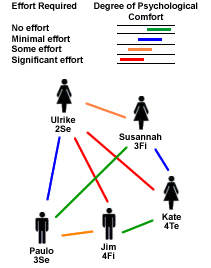
The team above highlights those who are likeable and those who are not. For example, encouraging Paulo and Susannah or Jim and Kate to foster a closer working relationship is to the benefit of themselves and the team. In the same vein, being able to predict the quality of these relationships then gives HR or management a clear basis for decision making and ensuring that people, where possible, work with those who they like. From a 4G standpoint, predicting relationships within teams is possible via the use of Social Relationships.
The second point is how do people react to those team members or employees who are both incompetent and likeable?
Posted in General, Psychology Leave a comment
Hero's Code
Apologies for the lack of new posts recently, I've just returned from a trip to Spain. I'm slightly burnt but have a smile on my face 🙂
I've recently been introduced to Derek Jones' blog, Hero's Code. Derek talks about his experiences as a coach and introduces us to some of his own perspectives and opinions on a very broad and diverse field. In a post entitled 'Be a Childlike Coach', Derek talks about living in the present, as opposed to the past or the future! Here's a excerpt that sums this up very well;
The great thing about watching young children play is that they care not at all for the past or the future. Their whole attention is just on the present time and these guys were fully "in the moment" all right. They are for the most part wild and carefree when at play, and not at all burdened by the responsibilities that adults tend to use as an excuse for their miserable demeanor.
When you really think about it, adults are generally not too good at this "living in the present moment" stuff. Even though the only time we can truly experience feelings, whether good or bad, is in the present moment, it is rare that these feelings seem to be linked to present events.
Personally, I believe that living in the present moment is the only way to go. Other bloggers are also picking up on this theme. Adam Eason writes about Engaging in the Moment, Louis talks about Heart @ Work and Spirit Rambler has a post on Looking for Self.
Posted in General Leave a comment
HR can't get no satisfaction (again)
Following on from our own post on levels of happiness within HR, Personnel Today have also picked up on the same survey in their article entitled 'Tears on my pillow: why is HR so unhappy?'.
As I've said before, I think the issue is one of perceptions within an organisation and the apparently schizophrenic (or Shadow-like) response that specific parts of an organisation can have. Extracts from the article follow;
"I've been in HR for 27 years and the profession has always been unhappy. There is too much naval-gazing and most of the problems are of HR's own making," Paul Kearns [said]. [However,] Angela O'Connor, vice president of SOCPO and HR director at the Crown Prosecution Service, refuted claims that HR is suffering a communal melancholy. So, the experts' opinion is split and it seems the profession has something of a schizophrenic mindset, with HR either ecstatic or chronically depressed, depending on who you believe.
It is interesting that this piece links in rather well with others online. Ian McKenzie, Regina Miller, Lori Dorn, Diane M. Pfadenhauer, Jim Ware and Critic have all written a similar piece in response to Liz Ryan's article, “Why HR Gets No Respect”. Slightly tangental, but I believe that happiness and respect share a strong relationship. Links to their pieces are below;
The Rodney Dangerfield of the corporate world?
HR as a Scapegoat
Was it something we said
Respect for HR
Administrivia
Scapegoating HR
From my own perspective, I believe that a move towards an integrated model of HR, an idea which is hinted at in an article called 'An Integrated Model for Strategic HR', is perhaps the best contribution I believe I can make at the moment. However, if you don't want to read it, the story in a nutshell is that HR would benefit from a model that created a series of direct links across the employee life cycle. In other words, just as all aspects of a company's finances are run through one or a combination of the balance sheet, P&L or cashflow statements, so HR would benefit from a similarly simple management structure. If a simple structure was able to touch all aspects of the employee life cycle and it attracted explicit decision making, at least in part, HR would be in a far better position...
Posted in Strategy 3 Comments
Association of Career Professionals International
Simon Hamm has very kindly asked me to give a talk on 'Career Success and Succession Planning' to the London Chapter of the ACPI. The date is the 28th June at the new IoD (123). I'm hoping to talk a little about some of our ideas and thoughts around what makes for good careers guidance and hopefully have some time to talk about how 4G fits into this picture. The following quotes really sum up our thinking and stance on the issue;
“The creation of something new is not accomplished by the intellect but by the play instinct acting from inner necessity. The creative mind plays with objects it loves.” Carl G. Jung
“The people who get on in this world are the people who get up and look for the circumstances they want, and, if they can't find them, make them.” George Bernard Shaw
“Work and Play are words used to describe the same thing under different circumstances.” Mark Twain
The event is open to ACPI members and non-members, so if you're in the area, it would be good to meet you. If you want to see what other people are thinking about career's guidance, have a look at Curt Rosengren's excellent Occupational Adventure and his post on Intuition as a career guidance tool. Another site to have a look at is the Being Bold Blog which is written by Ian Christie. Have a look at Ian's post on the Weekly Workout Log which looks like a good idea. Finally, we can't forget our own post on Stuart Lindenfield's up and coming book, Confident Networking for Career Success and Satisfaction.
Posted in General Leave a comment
4G and Social Relationships (cont.)
Building on from the previous post and the idea that there are 14 Social Relationships, I thought it would be worth introducing and examining some of these relationships one by one. I won't go through all 14, but hopefully this post will give you a flavour.
The first that is worth mentioning is Relationships of Action. In essence, this is all about creating energy, new ideas, brainstorming and motivation between two people. These ideas are well reflected in a post entitled 'Energisers'. You could think of this relationship like a set of spinning gyroscopes, constantly firing off one another and creating lots of noise and activity in the process. Now, while this relationship is ideal for motivation, there is a slight danger that the partners burn each other out or they run out of energy.

The second relationship is a Relationship of Reflection. This acts rather like a mirror and just as a mirror highlights imperfections and is used to guide delicate work (e.g. make-up or shaving), so Relationships of Reflection are a source of critical insight and are ideal for correcting problems or oversights.

Both of these relationships are Green and can be seen as being very positive and for the benefit of both people. What is also interesting is that while these relationships require 'no effort', they also represent differences in thinking styles and approaches adopted by the various people involved. In particular, there is no cloning taking place here!
Posted in 4G Leave a comment
4G and Social Relationships
Our first post in the 4G category (An Introduction to 4G) was an attempt to introduce some of the key ideas behind 4G and give people an overview. In this post, I'd like to explore the Social Relationships in a bit more detail.
As you can see in the diagram, there are different grades of relationships, ranging from 'no effort', through to 'significant effort'. The main idea in this instance is to outline that certain relationships are more preferable than others. In addition, this grading of Social Relationships creates a framework for decision making, facilitation and interventions.
What is also worth mentioning is that behind the simplified grading in the diagram, there are actually 14 Social Relationships in total. This then creates a far more complex and 'rich' context with which to apply the insights from 4G.
To the best of our knowledge, we don't know of any other tool or technique which offers such predictions, or insights. We are aware of the work of Fiske and Kenny who have put together other means of understanding relationships but they don't seem to offer such predictions or insights.
Posted in 4G Leave a comment


