HR can't get no satisfaction

Steve over at Catbert quotes a recent Guardian Survey in which HR workers are the unhappiest of all.

In the UK, the workers who were most happy in their jobs were those who worked in research (59%) and engineering (53%). Those who were least happy at work were employed in sales and customer service (38%) and management (45%). The most unhappy position in the UK is in human resources (39%).

While there is lots of talk about money and health benefits, what I really wonder is how much satisfaction people get from their work and how much they feel they are able to contribute? Not discounting hard cash, but I think some of the reasons for HR being bottom of the list are due to the variously quoted perceptions that HR has, both by people within and outside of the profession. Adspar and Vinay Talwar have also written about the perception of HR. For my own sins, I am sure a good dose of 4G would help 🙂

Posted in Strategy | 1 Comment

Rational v. Irrational Attitudes

We are not all rational, some of us are of course irrational, it all depends on our attitude...

I came across a post by Stowe Boyd who was talking about something written by Suw Charman. In essence, the posts seemed to introduce a debate of people as rational or not rational.

We are not rational beings. None of us. We like to think that we are, we like to point to logic and reason as our cornerstones, but still, we are not rational. We are emotional, passionate, illogical beings, and the sooner we realise it the better.

While of course this always a good starting point, from my own perspective, I'd just like to add that in my own mind, there is a healthy split between those that, given their psychological attitude, are rational, whilst others are irrational. As an attempt to try and clarify my thinking, have a browse of these extracts I've taken from Jung's Psychological Types (1921).

Rational

The rational is the reasonable, that which accords with reason. I conceive reason as an attitude whose principle it is to conform thought, feeling, and action to objective values. Objective values are established by the everyday experience of external factors on the one hand, and of inner psychological facts on the other. Such experiences, however, could not represent objective ‘values’ if they were ‘valued as such by the subject, for that would already amount to an act of reason. The rational attitude which permits us to declare objective values as valid at all is not the work of the individual subject, but the product of human history.” (Jung, 1921, p. 458)

Irrational

I use this term not as denoting something contrary to reason, but something beyond reason, something therefore, not grounded on reason. Elementary facts come into this category; the fact for example, that the earth has a moon, that chlorine is an element, that water reaches its greatest density at four degrees centigrade etc. Another irrational fact is chance, even though it may be possible to demonstrate a rational causation after the event. The irrational is an existential factor which, though it may be pushed further and further out of sight by an increasingly elaborate rational explanation, finally makes the explanation so complicated that it passes our powers of comprehension, the limits of rational thought being reached long before the whole of the world could be encompass by the laws of reason.” (Jung, 1921, p. 454)

Attitude

For us, attitude is a readiness of the psyche to act or react in a certain way. The concept is of particular importance for the psychology of complex psychic processes because it expresses the peculiar fact that certain stimuli have too strong an effect on some occasions, and little or no effect on others. To have an attitude means to be ready for something definite, even though this something is unconscious; for having an attitude is synonymous with an a priori orientation to a definite thing, no matter whether this be represented in consciousness or not. The state of readiness, which I conceive attitude to be, consists in the presence of a certain subjective constellation, a definite Combination of psychic factors or contents, which will either determine action in this or that definite direction, or react to an external stimulus in a definite way.”(Jung, 1921, p. 415)

Posted in Psychology | Leave a comment

New Thinking in Psychology and Psychometrics – Disattenuating Correlations and Validity

Continuing some of the themes picked up by Paul Barrett in his piece on Validity and Utility in I/O Psychology, he questions the use of disattenuating correlations and the impact this has on validity and practice.

In essence, a disattenuated (or corrected) correlation is a formula for deriving the true correlation with measurement error removed. While we could easily get bogged down in statistical argument and theory, especially if measuring an entire population, as opposed what happens in practice which is that a subset of a population is analysed, the key point, as posed by Barrett, is to ask what is the point of these corrections and what are the impacts on practice? In answer to the first question he writes;

To see what the maximum possible value for a relationship might be if there were no measurement error. This value cannot be used in practice – it yields a hypothetical value that is useful for theory purposes, and for examining the effects of measurement error on a relationship. That’s all.

Regarding the use of such information, Barrett then goes on to say;

These “operational validity” = disattenuated values are equivalent to those presented in the Hunter and Schmidt meta analysis of 1998... which just goes to show the problem faced by practitioners when using meta-analytic evidence to try and make sense of job performance within groups of employees within companies. i.e. great for knowing that engineers need a high level of ability as against a mechanic, but not much use for figuring out who is your best vs worst engineer.

In other words, using this sort of approach is fine when comparing two different skills or professions, for example accountants and sales staff or nurses and teachers but when used to identify exceptional people (on either extreme) from within the same skill set or role, the use of such data has little use. The implications of this research and its conclusions then have further impact on the use of competency based approaches to managing people and Human Capital Management which I'll go on to look at in another post.

References cited by Barrett;

Schmidt, F.L., & Hunter, J.E. (1998) The Validity and Utility of Selection Methods in Personnel Psychology: practical and theoretical implications of 85 years of research findings. Psychological Bulletin, 124, 2, 262-
274.

Schmidt, F.L., & Hunter, J. (2004) General mental ability in the world of work: occupational attainment and Job Performance. Journal of Personality and Social Psychology, 88, 6, 162-173.

Salgado, J.F., Anderson, N., Moscoso, S., Bertua, C., de Fruyt, F., & Rolland, J.P. (2003) A meta-analytic study of general mental ability validity for different occupations in the European Community. Journal of
Applied Psychology, 88, 6, 1068-1081.

Posted in Psychology | Leave a comment

An introduction to 4G – Predicting Relationships

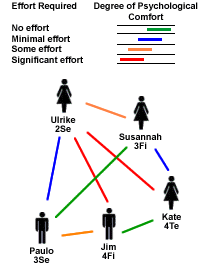
This post is designed to introduce some of the ideas surrounding 4G and its applications. In essence, 4G articulates and predicts relationships (Social Relationships) and culture (Social Groups) in a systematic and logical manner. Also present within 4G is the ability to rank or grade the quality of relationships between people from 'easy' to 'hard' in terms of the amount of effort required and corresponding levels of morale, performance and productivity. The following diagram illustrates this grading of relationships.

Team Building diagram looking at relationships, teams and predicting team relationships

As can be seen, there is a mixture of different relationships amongst the group of five. In particular, Paulo and Susanna and Jim and Kate both share very easy relationships and accordingly, they work very well together. On the other hand, Ulrike and Jim and Ulrike and Kate have a far harder time of things. They need to spend more time, energy and effort in order to achieve the same levels of performance that people with other relationships do.

There are many people who talk, write and blog about relationships and hopefully our take on predicting relationships will add to this thinking.

Posted in 4G | 1 Comment

IQ's Corner

Many thanks to Kevin McGrew who picked up on our post New Thinking in Psychology and Psychometrics - Part 1. Kevin very kindly reviewed our blog in his entry here. Kevin describes his blog as;

An attempt to share contemporary research findings, insights, musings, and discussions regarding theories and applied measures of human intelligence. In other words, a quantoid linear mind trying to make sense of the nonlinear world of human cognitive abilities.

I'm looking forward to reading more about Kevin's thoughts and thinking and if psychometrics and psychological measurement are your thing, pop over and have a browse.

Posted in General | Leave a comment

Ask Team Doc

I've been reading blogs for a while now and felt it was about time that our own list of links were updated. The first new addition is Denise O'Berry's 'Ask Team Doc'. Denise's style takes on that of a Q&A session. To give you a flavour, here's an extract from a recent post;

My subordinate has worked with me for 6 years. Overall, her performance is very strong and she handles most of her responsibilities in a timely and thorough manner. However, due to the small size of the organization, there’s no real opportunity for growth here.... It’s time for another performance evaluation… any suggestions? I’d love for her to make the decision to leave on her own rather than firing her, but I don’t know how to even broach this with her.

An extract from Denise's reply

OK, so where do you start? Set up a meeting with this employee. Plan for the meeting by identifying what you want to discuss, what possible action plans might be and what you expect to have accomplished when the meeting is over. When the meeting occurs don’t just talk. Listen. Listen very carefully to what she has to say.

It's great to get under the covers of some real issues and to hear Denise's advice and recommendations.

Posted in General | Leave a comment

New Thinking in Psychology and Psychometrics – Part 1

I recently made mention of Paul Barrett's critique of the current state of psychology and psychometrics, especially with regards to business, industry and organisation. Paul has written an extensive piece which in essence

seeks to offer a sample of several fairly recent major publications and abstracts from a variety of authors which seem to indicate that the current paradigm of psychology and psychometrics is beginning to “dissolve”.

The presentation cites a large number of published papers which collectively, build a very persuasive argument that the current paradigm is under increasing pressure. There are lots of pieces in the blogosphere which mention psychometrics, but over the coming days, I'll extract some of the more salient and digestible points. However, if you can't wait, the presentation can be downloaded here.

Posted in Psychology | Leave a comment

Change or Die/Live to Change?

Eva Kaplan-Leiserson drew my attention to a Fast Company article called "Change or Die". The article itself is good for drawing attention to the nature of change.

Kotter has hit on a crucial insight. "Behavior change happens mostly by speaking to people's feelings," he says. "This is true even in organizations that are very focused on analysis and quantitative measurement, even among people who think of themselves as smart in an MBA sense. In highly successful change efforts, people find ways to help others see the problems or solutions in ways that influence emotions, not just thought."

Unfortunately, that kind of emotional persuasion isn't taught in business schools, and it doesn't come naturally to the technocrats who run things -- the engineers, scientists, lawyers, doctors, accountants, and managers who pride themselves on disciplined, analytical thinking. There's compelling science behind the psychology of change -- it draws on discoveries from emerging fields such as cognitive science, linguistics, and neuroscience -- but its insights and techniques often seem paradoxical or irrational.

I think the above is characteristic of many manager's challenges and difficulties when it comes to change - how can the science and psychology be applied - we've already had some thoughts on this subject here. Additionally, while I fully endorse such sentiments, in the same breath, I also believe that there is a better perspective on this classic issues which was recently outlined by Dave Flemming.

Yesterday's mantra of "Change or die" will evolve into a new mantra for the future: "Live to change." Organizations must stop characterizing change as a mere event to be endured and learn to tap the possibilities that emerge from change as teacher and transformer. Herein lies the future — allowing change to shape the organization so that the organization can shape change.

Posted in Culture | Leave a comment

Managing the Informal Organisation

I think the realisation that the informal organisation, i.e, the one that is in people's heads, rather than that which is posted on the org. chart, is of equal or greater value is a good thing. What is even more exciting is that we think 4G gives people the ability to measure and manage it! A number of people have been commenting on a study in ComputerWorld to this effect. This extract is taken from Jim Ware's The Future of Work

The study, reported recently in ComputerWorld, found that informal groups that developed around informal experts and communicated openly about a problem generally outperformed formal experts who were attacking the same issue.

Jim goes on to ask

Why do organizations seem so oblivious to the intelligence and expertise of so many of their members? Sure, it's messy and often time-consuming to get everyone involved - but the results are often astounding.

I think the key is that such an informal approach has traditionally been hard to measure and manage in a conventional sense, not to mention the issues around privacy and big brother. Stowe Boyd has also mentioned that

Management will continue to believe in the decision making powers of formally designated decision makers, even when there is increasing evidence that the distributed intelligence in social networks is smarter than the org chart.

From our own perspective, we believe that giving people access to tools like 4G and Visible Path then enables them to get the most out of such situations and turn an unknown into a known.

Posted in Culture | 2 Comments

Relationships and Personality Testing

Over at George's Employment Blawg, George Lenard draws our attention to various personality tests and different takes on them.

For newer readers of this Blawg who may have missed it, we've previously posted some fairly detailed (and in my case somewhat goofy) stuff on the general topic of personality testing and employment.

I'd just like to add to the list with our own, newly validated instrument 4G 🙂 Our own special sauce is predicting relationships and culture and introducing a series of optimal team and OD structures. We've got some examples on the applications of 4G in recruitment and team building amongst others.

Posted in Psychology | Leave a comment