Management Jargon

Some more wordology! I found these charmers via Thad at the Monster blog. I'll just repeat the phrases themselves, feel free to visit the post for the definitions.

“At the end of the day”
“The 50,000-foot perspective”
“Pushing the envelope”
“Making lemonade out of lemons”
“All things being equal”
“All people being perfect individuals…”

I've never heard of the 50,000-foot perspective though?!? On the same subject, Zef Hemel wrote a post looking at the deployment of such jargon and how smart people ensure that...

Their convincing strategy consists of firing relevant and irrelevant facts at you at an unbelievable pace. They continue doing this until you give up and you say “ok, you’re probably right.”

Hopefully we're all now better off to combat such oral assaults 🙂

Posted in General | Leave a comment

HR Value and Influence Delivered

I read a great story in Personnel Today looking at the HR function at Home Depot - Home Improvement. The two juicy bits are the rapid rate of growth and the pay of the HR director. On the subject of company growth;

The company's rate of expansion in recent years has been huge. When Donovan joined in 2001, Home Depot had 1,319 stores and 251,488 staff. These figures have since grown by 44% and 29% respectively.

Looking at the rewards of Dennis Donovan, the CEO who hired him, Robert Nardelli is

reported to have paid Donovan a whopping $21.5m (£11.3m) for his first year at Home Depot, in line with the ranking suggested by Peters (a recent survey of HR directors' pay estimates Donovan's total annual pay package is now $6.4m (£3.4m) - the second-highest of any HR director in the US).

How does Donovan do this? The answer seems to be driven by his personal influence, the value that he contributes and the fact that this is recognised by others in the business, not least the CEO.

His value is also reflected clearly in the amount of influence he enjoys at the company - more like that of a traditional chief operating officer than a traditional HR director. He helps to mould and disseminate company policies; he involves himself in everything from the financial performance at store-level to supply-chain management, to the procurement of new IT systems; and he meets major shareholders every eight weeks and addresses a conference of analysts twice a year.

If you want to look under the covers, here are some interesting perspectives on Home Depot and how they do it.

Commentary on the Home Depot HR strategy - The Home Depot Goes for Gold

For The Home Depot, focusing on employees and their success outside the big-box store powerfully delivers several key messages: (1) we respect our employees and their individual skills and pursuits; (2) the people you find working in our stores are passionate and driven about what they do; (3) price is not our differentiator: our service and experience and support will carry you through your own DIY effort.

The fly on the wall perspective - Home Depot Bet Bet Weblog

Many people asked what it was like to spend 16 hours in the home depot. For those who want to know I provide you with a transcript of the journal that I kept during the event.

The Home Depot brand - Do you have a Home Depot problem?

Walk into the store and you can see which worldview the story is tailored to. It's not for the homemaker or the occasional do it yourselfer. No, the store is clearly designed by, stocked for and organized around people who buy in volume and, even more than that, hardware geeks.

Posted in Strategy | Leave a comment

What are Bioteams?

I stumbled across Ken Thompson's blog which looks at Bioteams. This is a new idea to me, but I like the sound of self organising teams, developing some of the biological metaphors and applying them to organisations and teams.

Ken's posted a glossary on bioteams which outlines some of the core ideas. The entry for Bioteams reads

A Bioteam is an organisational team which operates on the principles embodied by natures most successful teams including ants, bees, geese, cells. micro-organisms and termites. All these teams share common traits which have emerged through millions of years evolutionary experience and include self-organisation (autopoiesis), indirect communications (stigmergy) and emergent behavior....

I'm looking forward to learning more and to see how the Bioteams idea overlaps or connects with 4G, or not, as the case may be! If nothing else, it looks like a great metaphor though.

Posted in General | Leave a comment

4G Research – Validity and Reliability

For those people interested in the statistics and research behind psychometrics in general and 4G in particular, we've just added a new page to the site with a summary of the reliability and validity of 4G. This is only a summary and there is more if you register. That said, if there is anyone who has an interest in this work, or would like a copy of the full test manual, I'd welcome the chance to chat in more depth 🙂

Posted in Psychology | Leave a comment

Character traits and their use

There is always lots of talk of competencies, traits and the links to performance. I think there are basically two ways to cut this cake. The first, as implied by Rebecca Thomas and Curt Rosengren, looks at the use of use traits as a means for development, self awareness and as a means of helping you improve various activities and attitudes

It can never be said enough that the person who controls your direction in life is yourself. You control your activities, your attitude, and your fear. Once you accept those and start building them into a positive force for yourself, you are headed toward being successful, regardless of your definition of that term.

I think the second, empirically based approach is far harder to extract clean and tangible value from. I was reading a paper recently which caught my eye on this matter. "Personality and Performance at the beginning of the New Millennium" (link to pdf) reviews c. 100,000 individuals and 1,000 studies which try to link personality to performance. At the end of the day, the authors conclude that there is not much more juice to come from this particular orange

While much has been learned from this body of evidence, we believe that little is to be gained from further meta-analytic studies of this type. Consequently, we call for a moratorium on such studies, and suggest that researchers embark on a new era of research along (but not limited to) the areas we outline above.

Paul Barrett has taken this idea and many more on board and written a succinct and superb critique of the current psychological paradigm. The symptoms of the current paradigm include the questionable mantra that links individual personality to significant and valid predictions of performance. For our own sins, we prefer to focus on the links between relationships and performance 🙂

Posted in Psychology | 1 Comment

The changing role of HR

I read an interesting piece on the evolution of the HR function within organisations and organisational culture. Just as IT and Finance departments mature, so does HR. This author, writing partially from a Japanese perspective at least, comments

* The role of HR in the 1990s was champion changes to culture and behaviour within the organisation to allow 'total quality' to be imported. This had to happen at every level: from boardroom to shop floor.
* HR in the 21 century is seeing a devolvement to line management. However, this trend is challenged by both HR professionals and line management - at least in the way that the model is applied.

I couldn't agree more about the challenges and alternative agenda's that must be tackled and resolved if progress is to continue. We recently wrote about the strategic perceptions of HR within the business and the potential organisational (department) shadow, both of which will have various levels of influence on the HR agenda moving forward.

If you can view this page on the CIPD website, you'll see the debate is very much alive, with over 50 posts at the last count.

Posted in Strategy | Leave a comment

Transitionist – Get it before its gone

A great bit of lingual humour via Terrence Seamon who mentions the newly minted term "Transitionist"

Transition is most esentially about change and thanks to the suffix '-ist' to be a transitionist is to be adept at transitions and more precisely (or is that abstractly?), skilled at managing change.

Managing and dealing with change is a skill that is thrust upon entitys regardless of their response. Change is unavoidable, whatever form the change or the object of that change may be. There are infinite things that may change. Change comes in all forms and nothing is exempt. Even the most constant forces are changing, perhaps impercepably but still they are changing.

It's marked for deletion at Wikipedia, but get it while you can, unless you want to go via Google... 🙂

Posted in General | 2 Comments

Putting a number on HR?

Andrew Weissman picked up on the popular theme of measuring and placing a value on HR. Andrew wrote

In exploring the concept of how to measure the return an enterprise receives from its investment in people (the largest single investment made by every organization), I wondered how many companies actually measure this, and if they did what metrics they used.

Here in the UK, at the moment it is an uphill battle to ensure that companies report on their HR metrics. We made mention of this in April when we wrote Taskforce members ignore own advice on people data - Part 2.

While there is no doubting the links between people and performance, the ability to measure this is of course a step in the right direction (see DoubleStar for example). However, as Andrew Marritt writes, it's no easy feat!

My take on one of the reasons that HR has a low credibility in most organisations is that it tries to 'copy' other parts of the organisation only to make a mess of it. Most senior management with any comprehension of numbers will soon see the weakness of either ROI of recruitment or Quality of Hire. Go in with a dollar value of the economic contribution that an individual makes and most will probably smile sweetly and then smirk behind your back. Either that, or want to understand how you modeled accurately a whole organisation. Remember if you had an accurate model they could then manage it perfectly.

I couldn't agree more with Andrew and believe that the challenge basically boils down to one of value. Not in a purely statistical or empirical sense, but in winning influence and buy-in from other parts of the firm. This is the real challenge and is still up for grabs in my mind.

Posted in Strategy | Leave a comment

Covert and Overt Management Styles

Tom at the wonderfully titled "HR for the leader in you" has written of another example of traditional, covert management styles that clearly don't cover the whole piece;

A man came up to me after my speech on leadership the other day and said, "I work for a company that does just the opposite of what you call for in your presentation." That is not all he told me, but that is all I will repeat here. The ideas I put forward are so basic and so humble that it amazes me each time I get the reaction I did from the aforementioned gentleman.

I might add that the gentleman works for a very public company (one that you would all know), which is in trouble. They have cut, cut, cut and negotiated give-backs; it is not pretty. His descriptions were troubling not because they don't agree with mine, but because the company has failed at managing the change that is so necessary. Instead of wanting to help get his company back to profitabily, this employee made me feel that he wants to see it go under.

This example makes me think of an earlier post we wrote on Organisational Culture, Transformation and the use of Role Models.

Posted in Culture | 1 Comment

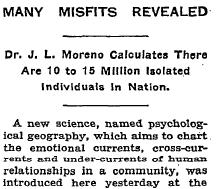
Emotions Mapped by New Geography

Bruce Hoppe caught my eye with a rather fetching historical article on Psychological Geography! I've included the picture below and you can find the original here. The original is from the New York Times, 3rd April, 1933.

Emotions Mapped by New Geography

Whatever happened to Psychological Geography? By the looks of things, its alive and well 🙂

Posted in General, Psychology, Technology | Leave a comment