Changing the way Collaboration and Communication is managed

A classic (it was published in 2005!) from Stowe  Boyd on Social Software. Much of it has come to pass, but its nice to look back and see the connections. I particularly enjoyed his conclusion, the full effects of which are still a long way off...

Perhaps just as interesting as the way that social software is transforming group interaction, across different time zones or in the same room. Social software is destined to have a huge impact on how businesses get at their markets. So the essential elements of social software will be incorporated into more conventional software solutions, changing the way collaboration and communication is managed within and across businesses, and ultimately transforming how companies sell and interact with customers.

Posted in General, Teams, Technology | Tagged , , , , , | Leave a comment

How can HR best help the CEO?

How can HR best help the CEO? I think that HR’s standing in the eyes of most of the current generation of CEOs is so low that any thoughts of a key strategic role is more wishful thinking than imminent reality.

Instead, by focusing on three areas: relationships, culture and talent, but in new, more innovative ways, HR can potentially make a significant day to day impact on the CEO and other senior executives.

Presuming the average CEO has between 8 and 12 direct reports, dealing with these relationships must take up a considerable amount of time and effort. These relationships, their dynamics and productivity are likely to play a key role on the CEOs perception of their own and the organisation’s performance. Even as an organisation’s leader, it is impossible to separate your own day to day experiences and take a global view of the organisation. For example, overall performance may be good but one or two of the CEO’s relationships with direct reports may be suffering.

By providing the CEO with the information and understanding to optimise their relationships and collaboration with those closest to them tools such as our own 4G methodology apply directly to this area, it is possible to make a significant contribution to senior level communication.

To support this, there is an interesting article from McKinsey Quarterly that emphasises the need for all managers to work at their relationship management and awareness of those around them:

“Bosses matter. They matter because more than 95 percent of all people in the workforce have bosses, are bosses, or both. They matter because they set the tone for their followers and organizations. And they matter because many studies show that for more than 75 percent of employees, dealing with their immediate boss is the most stressful part of the job.”

“The best bosses work doggedly to stay in tune with this relentless attention and use it to their advantage. They are self-absorbed, but not for selfish reasons. On the contrary, they know that the success of their people and organizations depends on maintaining an accurate view of how others construe their moods and moves – and responding with rapid, effective adjustments.”

Theoretically, HR is well placed to influence this and by systematically addressing the way each manager engages and conducts their relationships with subordinates, gains to performance and collaboration are achieved.

It is important to emphasise that this approach should not be confined to senior executives. Arguably, helping all managers improve their own relationships is the most effective use of the HR function. In a blog post, Meredith Wright cites an interesting quote from Robert Hogan:

“People don’t quit their job, they quit their boss.”

This entry is an extract from Four Groups’ Quarterly Update, originally posted here.

Posted in Strategy, Intangibles, Leadership | Tagged , , , , , | Leave a comment

Video – Management Due Diligence

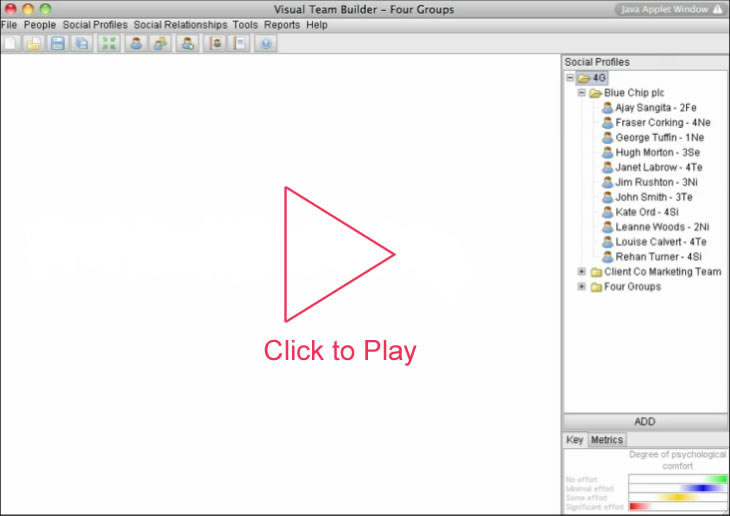
There's a now a video demonstration of 4G on the Management Due Diligence page. You can see the video below, or on the Management Due Diligence page.

Management Due Diligence Video Demonstration

Part 1

Posted in Strategy, Teams, Video and Audio, 4G, Culture, Intangibles, Leadership, Psychology | Tagged , , , , | Leave a comment

Ready, Aim, Fire… Business isn’t War…

Given the time and energy invested in activities such as engagement, talent development, finding 'untapped potential' and purpose, it's quite surprising to see elements of business language still being dominated by military metaphors from the last century.

Take, for example, 'Chief' (Executive or Finance) 'Officer', 'Execution' (of the business plan) and the use of 'Targets' (to aim for). And this is before we start talking about 'Annihilating' the competition.

I'm not sure if the contrast between implicit command and control type language on the one hand and attempts to motivate and engage people's passion on the other is particularly successful. Likewise, I don't know if other's are aware of this contrast, or if its just me. (Knowing me, I'm sure its just me...).

Either way, I don't think it helps either point of view progress much at all, whether you subscribe to either of theory X or theory Y.

Posted in Culture, Leadership, Strategy | Tagged , , , , , , , | Leave a comment

Is there really such a thing called talent?

A very thought provoking piece on talent from Magnus Holm, drilling into the details and questioning some of the assumptions.

In order to become great or excellent, you must keep practicing. Not mindless practice of course, but deliberate practice as Ericsson has described. Depending on the subject, the innate abilities or the physical attributes may help, but is not essential for reaching an expert performance. In many cases, having a talent makes no significant differences on the outcome, which therefore leads to the conclusion that, very often, “there is no talent”.

If talent doesn’t matter, what do you need then? Passion, passion and passion. By following your passion you will not only get better at things, but your life situation will also improve since you’re doing what you really want to do.

Might it be that passion is more valuable than talent? Are we inching our way past 20th century militaristic models of work or will there be a new 'war for passion'?

Posted in Intangibles, Leadership, Psychology | Tagged , , , , , | Leave a comment

By giving up the quest for ROI, can HR make itself indispensible?

For too long HR has laboured under the belief that if it can somehow conjour up tangible performance figures, it’s future as a strategic influence on the organisation will be guaranteed.

A recent HR Magazine article by Chris Roebuck highlights the ongoing search for hard numbers to back up the continuing existence of the HR function:

“How many HR functions have presented a clear case to their FD on the financial value they are likely to be adding? How many have identified specific initiatives that have delivered specific value to improve service to end users or customers?”

In seeking to show value, the result is that HR practitioners have been taking a macro view of the organisation, striving to provide a similar service to the organisation as the finance department in terms of crunching numbers and applying a uniform approach to their areas of responsibility, hiring, firing, talent etc.

Without doubt, analytics are here to stay and are likely to play an increasingly important role in organisational planning and development. For example, Cathy Missildine-Martin has a blog post about a recent HR Magazine article by Dave Zielinksi that looks at the composition of Google’s HR team:

“ 1/3 of the HR team have HR backgrounds and bring expertise in employee relations along with other specialist expertise like benefits and compensation. 1/3 of the HR team has little or no HR background and come from strategic consulting firms or internally from Google’s sales and engineering departments. These individuals are embedded in the business as consultants. 1/3 of the HR team are the quant jocks. They are statisticians, PhD’s in finance and organizational psychology. Their job is organizational analytics especially the predictive kind.”

There are a couple of interesting things, firstly that 1/3 of the HR team has little or no HR background. This emphasises the fundamental need for a commercial understanding of the business. Secondly, the analytics are supplied by specialists in esoteric and complex areas such as cognitive heuristics. I was particularly interested in the emphasis on predictive analytics. This flies in the face of the traditional dashboard type information gathered and processed by the HR department. Unfortunately most HR departments don’t have the budget, infrastructure or data required to appoint such specialists.

A further example of the role analytics are here to stay and that advances in technology and creative thinking are bringing new insight into organisational performance are highlighted in a blog post by Gautam Ghosh:

“Many companies favor job candidates with stellar academic records from prestigious schools – but AT&T and Google have established through quantitative analysis that a demonstrated ability to take initiative is a far better predictor of high performance on the job.”

However, no matter how smart you are, the use of such analytics is unlikely to move HR up the corporate totem pole. Furthermore, the majority of HR professionals lack the necessary skills to drive this forward. Analytics are here to stay, but only as an offshoot of the HR function.

A question we keep coming back to is, is there an argument to be had that the way to get a strategic role is to give up the macro, organisational wide view and instead concentrate on micro issues? Alternatively, by giving up the quest to show ROI, can HR instead make itself indispensible?

This entry is an extract from Four Groups’ Quarterly Update, originally posted here.

Posted in Culture, Intangibles, Leadership, Strategy | Tagged , , , , , , , , , , , , , | Leave a comment

Compensation as a barrier to innovation?

We are seeing the role of compensation being held up as a barrier to many of the things that organisations actually want to achieve. For example, in a blog post Jeffrey Phillips, looks at how traditional compensation structures, particularly in large organisations can be seen as a barrier to innovation:

“The reason that compensation is such an insidious barrier to innovation is that we all share it and it’s not polite to talk about. No one wants to focus on compensation since it can be such a headache to revise and restructure, but there’s little doubt it is a serious impediment to innovation. Unlike some of the other barriers that can be overcome – few resources, few dollars, few insights – compensation affects everyone and it is a personal barrier as well as a corporate barrier. It’s hard to rally people round the innovation flag when they are looking over their shoulder wondering about how the innovation work will affect their compensation.”

“I think that when we strip away all of the other innovation constraints and blockades, we’re going to find a very small but very powerful disincentive to innovate, buried in how we compensate our teams.”

There is another interesting take on the role of group interaction on innovation in an article from Wharton. In this example it is interesting that the authors pick up on the often negative impact of managers on the innovation process:

“People like having a process because they understand that it’s fair. In a typical brainstorming meeting, it’s not fair and everybody knows it. The boss is always right.”

I think that this complements the idea that compensation can have a negative impact on innovation and also change. Current compensation models clearly have the effect of creating a hierarchy of ideas and built in bias towards certain people’s ideas.

This post is an extract from Four Groups' Quarterly Update, originally posted here.

Posted in Culture, Intangibles, Leadership, Strategy | Tagged , , , , , | Leave a comment

Video – What is Transformation?

Having read and responded to Jon Ingham's tweet about what is most likely to transform People Management in the next 5 years, I thought I'd take some time to add some thoughts around current  understanding of transformation.

Before the video, a bit of background. Naomi Bloom's post struck a chord, particularly the opener;

Forty years on, and we’re still talking about organizational readiness for strategic HRM (of which talent management is a large piece). Boring! The time for action is long past.

Likewise, David Graham frames the paradox of previous attempts at transformation very succinctly;

Despite the proven benefits of HR transformation, business executives and HR leaders alike continue to voice frustration with HR’s ability to deliver value. With no shortage of talented people doing great work, what’s the problem?

what is transformation video

[spoiler show="And for those in the UK..."]This video was recorded before the snow and with the indispensable benefit of central heating, hence I'm wearing just a shirt![/spoiler]

Posted in Culture, Leadership, Strategy, Video and Audio | Tagged , , , | 1 Comment

Leadership, Intangibles and Talent Review Q3 2010

Welcome to the Q3 Quarterly Update for 2010. After the Summer lull, we have seen some thought provoking articles surrounding intangibles, HR, innovation and leadership. We’ll also explore the following themes;

Articles are included from the likes of AT&T, the Financial Times, Hay Group, Hewlett Packard, Science Magazine, Wharton Business School and Zappos.com.

Leadership, Intangibles & Talent Q2 2010 - Four Groups.pdf

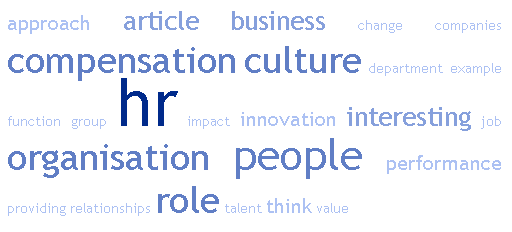
Tag Cloud

Leadership, Intangibles & Talent Q3 2010 - Four Groups.pdf

Continue reading

Posted in Strategy, Teams, Articles & Research, Culture, Intangibles, Leadership | Tagged , , , , , , , , , , , , , , , , , , , , , , , , , , , , , , , , | Leave a comment

Can you predict and optimise key components of collaboration?

Justin Kirby was very kind to do a writeup of our contribution to a NESTA funded research project he was involved in.

These ideas aren't dissimilar to what I wrote about re: Jackie Orme and I've added a short extract below.

Many large organisations claim to have excellent and world-class capabilities in:

  • Business processes
  • Collaborative software (video conferencing, blogs, wikis etc.)
  • Developmental support (workshops, training, coaching, learning etc.)

What appears to be missing from the client perspective is a methodology, system or tool (e.g. Kaplan Norton ‘Balanced Score Card’, Six Sigma, etc.) to help optimise collaboration, working relationships and productivity, particularly if a new
project is starting or a new initiative is under way.

So while the three areas mentioned earlier are very well understood by the majority of large organisations, a means or method to ‘scale’ collaboration and help enhance productivity in a systematic fashion is potentially a missing piece of the jigsaw.

By providing a systematic methodology and framework for decision making, research participant Bruce Lewin of 4 Groups has suggested that their 4G technology helps optimise the often ‘hard to manage’ or intangible elements of collaboration, namely working relationships, shared values and creative tensions that are part and parcel of any collaborative activity.

Posted in 4G, Intangibles, Psychology, Teams, Technology | Tagged , , , , , , , , , , , , | Leave a comment